Blaze
A software creation system built around structure, not guesswork
Converting Business Requirements Into Reusable Product Intelligence With Blaze AI
Shipping Enterprise Software Faster Without Sacrificing UX Consistency, Quality, or Control
Blaze is the proprietary product behind the Volt X delivery model. It helps convert business requirements, product patterns, UX architecture, data logic, and front end foundations into a controlled system for creating enterprise software. It is not a template library or a loose AI builder. Blaze gives every product a structured starting point, then allows Volt X to shape the software around the specific business model, workflows, permissions, integrations, reporting needs, and user experience.
Blaze exists because most enterprise software projects waste too much effort rediscovering the same foundations: users, roles, records, workflows, dashboards, approvals, permissions, reports, forms, tables, navigation, settings, and operational states. Blaze turns that repeatable knowledge into a software creation system. It helps Volt X start from structured product intelligence instead of a blank page, then customise the product around the business use case. The result is faster delivery without sacrificing product logic, UX consistency, engineering quality, or enterprise control.
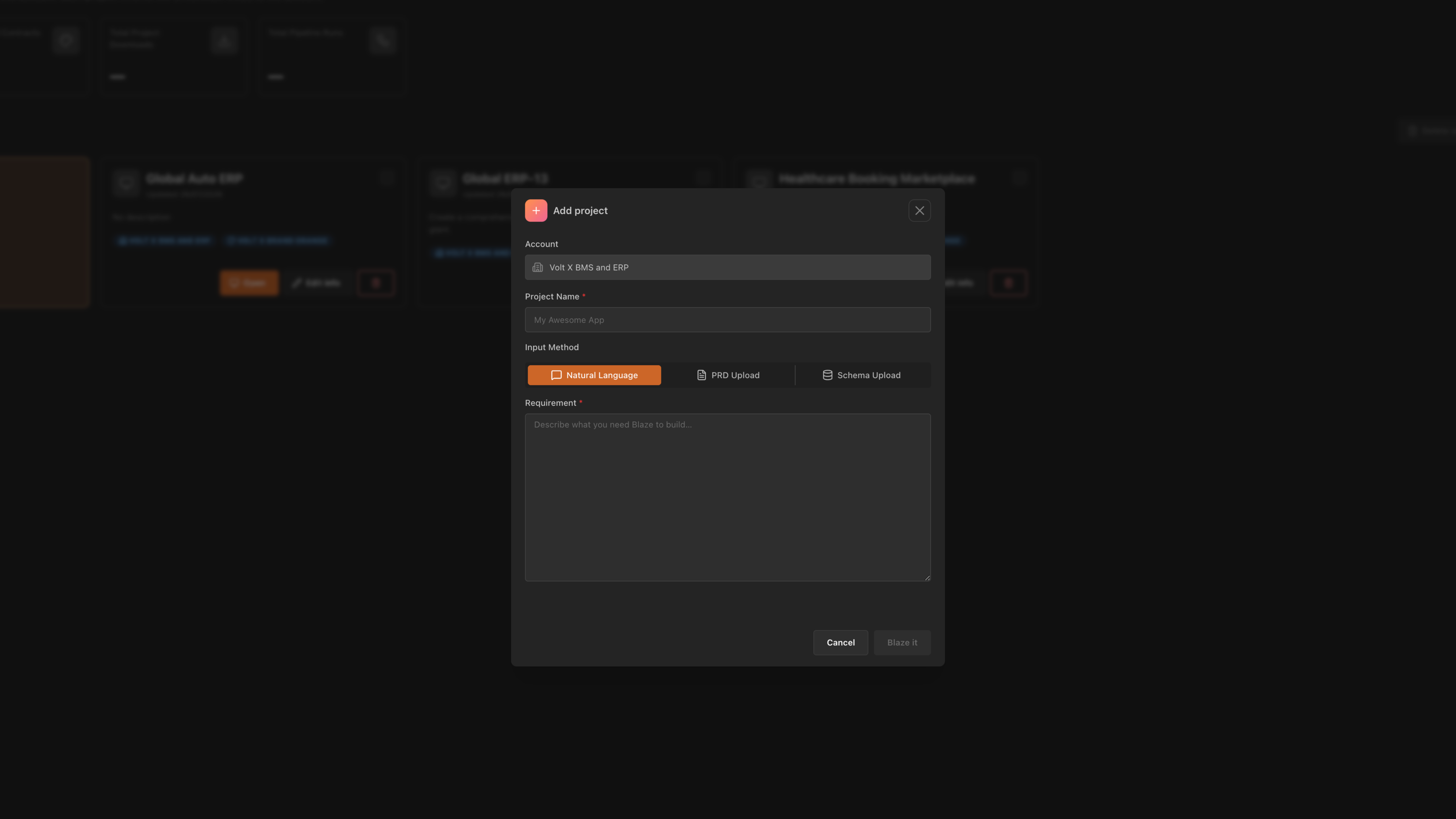
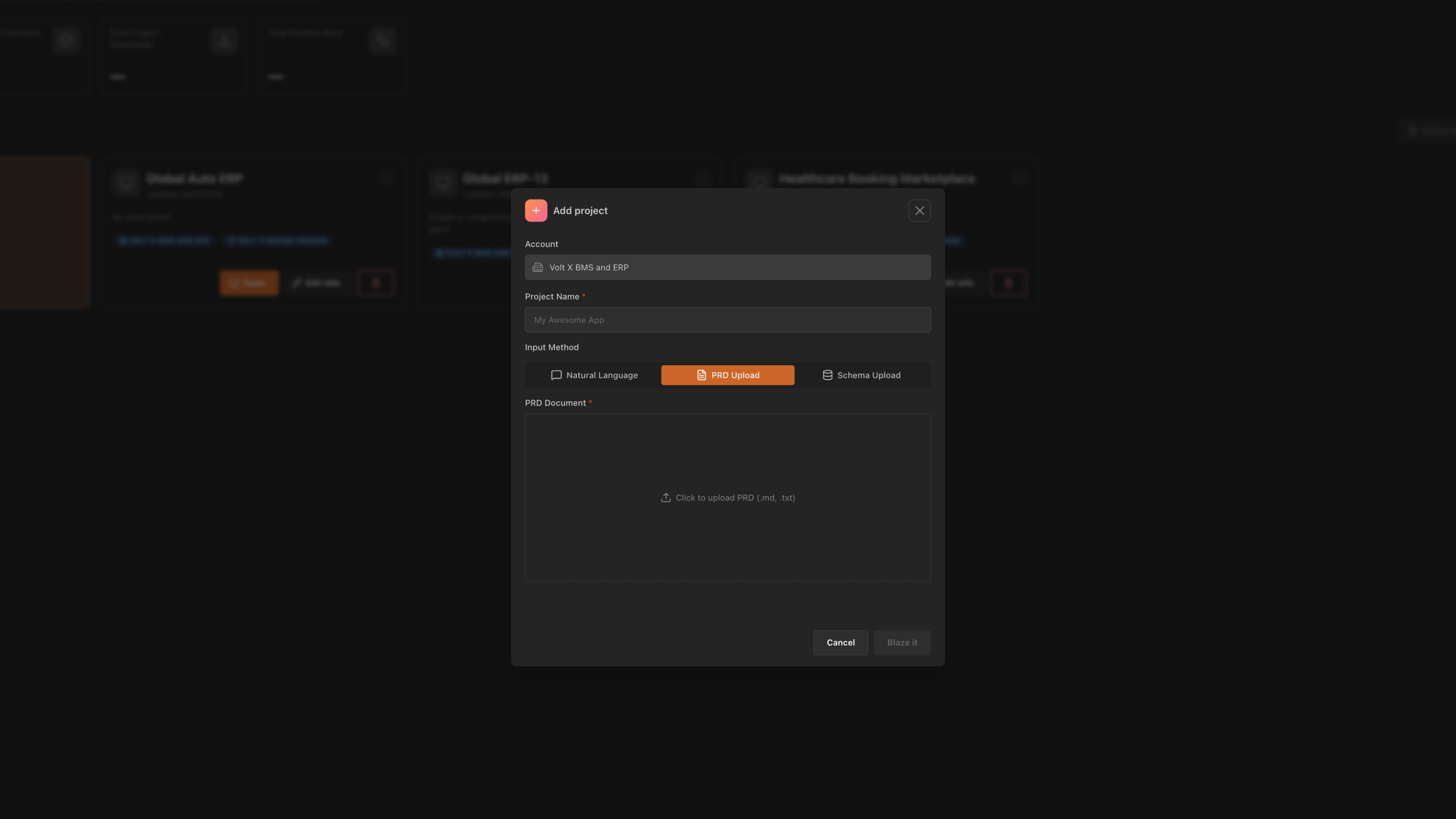
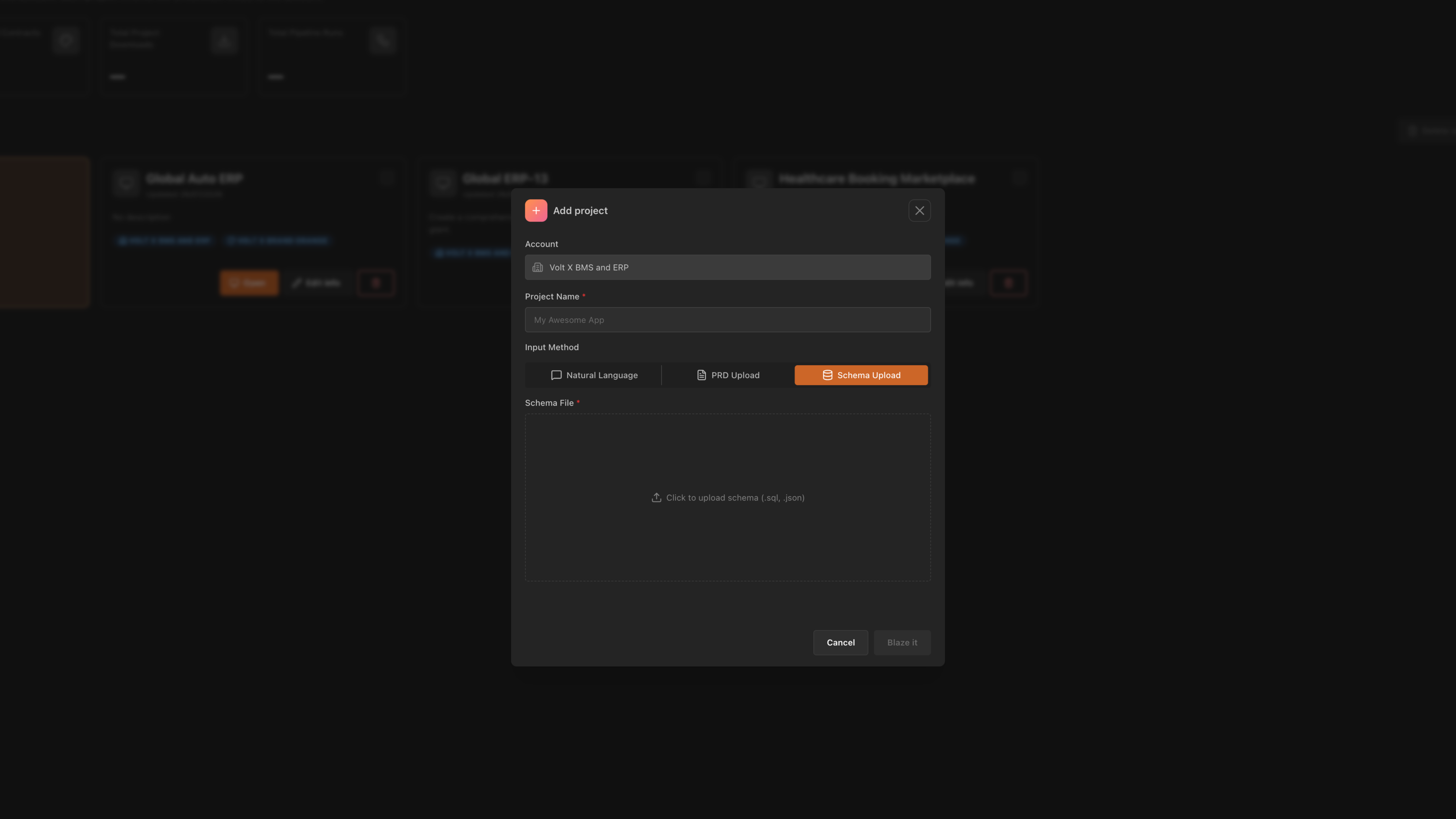
BUILD STEP 1 - MODE SELECTION
Your Build, Your Control
Choose how you want Blaze to build your software. Blaze offers three creation modes: Natural Language, PRD, and Schema. These modes define how you provide your product requirements, but all three run through the same deterministic engineering process, so the final code, architecture, and system performance meet the same production-ready, enterprise-grade standard regardless of which mode you choose.
Whichever path you choose, Blaze closes the gap between concept and production, delivering an enterprise-scale codebase that is ready to deploy.

BUILD STEP 2 - BLAZE PIPELINE RUN
Initiate the pipeline and let the automated engineering engine take over. Blaze will output ~90% of your product in one shot, in first iteration.
Once you select your mode in the previous step, click "Blaze It" to trigger the automated build pipeline. Your software moves through a sequence of specialised stages that enforce consistent architectural standards. At every stage, the pipeline runs the same three-part quality loop:
Each stage loops and self-corrects until the output meets the platform's software design standards.
Your application runs through more than 30 distinct build contracts, so the final delivery is a production-ready, enterprise-grade system.
BUILD STEP 3 - CUSTOMIZE AND EXPORT
Architectural Refinement & Sovereign Export
Close the final development gap and take full ownership of your standalone codebase. The initial pipeline run handles roughly 90% of the core engineering. To close the remaining gap, Blaze gives you built-in developer tools for making deterministic, database-aligned changes. Whether you are building a 10-screen utility or a 10,000-screen system, Blaze keeps the architecture consistent as you customise it. You can make changes through three areas:
Once your application is perfected, you can instantly export the complete repository or push it directly to your GitHub account. The exported code package functions entirely independently of the Blaze platform, leaving zero platform lock-in or runtime dependencies. You receive a clean, production-ready, enterprise codebase completely ready to deploy onto your own private infrastructure.
What Blaze ships today
Structured product foundations you can verify before export
Every export is built from typed application definitions, governed UI patterns, and validated build gates, not loose generation or vanity percentages.
The figures below reflect a typical mid-size enterprise application from Blaze. Your scope may differ; everything is inspectable in a Studio demo.
Modules
Blaze produces roughly thirty modules in total per generation. Business record modules plus identity, settings, dashboard, and navigation surfaces, composed as one coherent product rather than disconnected screens.
Fields
Eighteen fields on average per module, highly aligned to the business domain. Each module carries a typed field model with relationships, validation, and list or form presentation rules, not ad-hoc columns added screen by screen.
Operations
Page, row, bulk, and modal operations across modules, including create, update, approve, export, and domain-specific workflows authored as structured product behavior.
Patterns
Exported applications compose list, form, dashboard, IAM, workflow, and settings surfaces from a classified pattern library spanning nineteen product families.
Build Fundamentals
Blaze is built for teams that need speed without surrendering architecture discipline, code ownership, or export governance.
Sub-second execution speeds built for enterprise data scale
Traditional custom software teams often rely on client-side data processing or bloated transport layers that degrade exponentially under heavy enterprise use.
Blaze exports applications engineered for operational speed: server-side data logic, optimized indexing, and strictly bounded queries so lists, filters, and transitions stay responsive at scale, without massive hardware overhead in your environment.
Modules
Blaze produces roughly thirty modules in total per generation. Business record modules plus identity, settings, dashboard, and navigation surfaces, composed as one coherent product rather than disconnected screens.
Fields
Eighteen fields on average per module, highly aligned to the business domain. Each module carries a typed field model with relationships, validation, and list or form presentation rules, not ad-hoc columns added screen by screen.
Operations
Page, row, bulk, and modal operations across modules, including create, update, approve, export, and domain-specific workflows authored as structured product behavior.
Patterns
Exported applications compose list, form, dashboard, IAM, workflow, and settings surfaces from a classified pattern library spanning nineteen product families.
Audit-ready code foundations engineered to pass enterprise security gates
We do not believe in masking vulnerable codebases behind abstract compliance badges. Blaze architects every exported application from the first line to satisfy rigorous enterprise security audits, not cosmetic compliance theatre.
Standard, transparent engineering frameworks mean the codebase your team receives is designed to clear internal risk assessments and external security validations.
Client-side storage overhead
To align with UK GDPR and HIPAA expectations, Blaze data routing keeps sensitive processing server-side. Bounded query structures reduce browser exposure and data residency risk.
Open-standard comprehension
Blaze exports pure, human-readable web application code without proprietary runtimes. Your team can run standard vulnerability scanners and meet NCSC and CISA Secure-by-Design expectations.
Isolated access management
Presentation, application, and data tiers stay separated with role-based access controls that match the technical patterns enterprise IAM and SOC 2 reviews expect.
Defensive audit preparation
Predictable exported structure means your engineering team can prepare documentation for an external audit in weeks, not months of remediation after an opaque handoff.
FAQ
Frequently Asked Questions
Blaze is disruptive, and it is natural to have questions
Blaze is not an agentic coding tool, a prompt to app generator, or a generative AI vibe coding environment.
AI has a deliberately limited role in how Blaze fundamentally works. Blaze is a contract-driven software creation system built around codified product logic, enterprise UX patterns, typed application definitions, governed data models, reusable engineering contracts, deterministic compilation, and controlled quality gates.
Instead of asking an AI model to invent an application repeatedly from natural-language prompts, Blaze first establishes a canonical application definition covering modules, entities, fields, relationships, workflows, roles, permissions, actions, states, dashboards, reports, interface patterns, and business rules. The application is then generated, customised, tested, and extended against that persistent definition.
These frequently asked questions address the areas our customers most commonly ask us about. We are also happy to answer any additional questions through the Request Free Access form.

Pricing
No token trap. No subscription trap. You pay for the value you get.
- Free to access (no subscription fee)
- $3 flat fee for one-shot production of full application
- Free to patch and edit with Blaze Product Shape and UI Contract Builders
- Production code package priced via quote
Blaze delivers enterprise application foundations you can preview, verify, and own. You pay strictly for value created: one full pipeline run, then a scoped quote when you take production code away. No token trap, no expensive monthly subscription, and no open-ended chat spend with no guarantee the output is production ready or usable. Refine through the Product Shape form and linked UI contract at no extra charge. Volt X quotes download scope within 48 hours and sends an approved link to your email.