HR operations dashboards
Track employee records, onboarding progress, pending HR requests, document status, leave trends, attendance exceptions, open approvals, and HR workload.
Human Resource Management System
This HRMS manages the employee lifecycle end to end: recruitment, onboarding, payroll, benefits, and approvals, across complex organisational structures. Role-based access control keeps sensitive personnel data, contract terms, and compensation information encrypted and restricted to the right people. Employees get a self-service dashboard for profiles, time tracking, and performance reviews. Automated audit trails support cross-border regulatory compliance and give HR teams a transparent, defensible record. Priced at a sweet spot against typical enterprise per-user licensing, your initial investment can reach break-even quickly, then keep delivering savings year after year instead of ongoing subscription fees. Because Volt X customises each product around how you operate, the efficiency and performance gains in daily use can pull that break-even forward and help you see return on investment sooner.
A strong HRMS is not just an employee database. It is the operating layer that keeps people, policies, managers, HR teams, approvals, performance, and workforce decisions connected. Volt X HRMS brings employee data, lifecycle events, attendance, leave, payroll inputs, performance cycles, documents, requests, approvals, and people analytics into one governed product foundation. It is designed to match how your organisation hires, onboards, manages, supports, develops, and retains people without forcing HR teams into a rigid off the shelf model.
Volt X advantages
Volt X HRMS is built around the essential capabilities expected from a mature human resource management system. It covers employee records, organisation structure, onboarding, attendance, leave, payroll inputs, performance, goals, workforce planning, HR requests, documents, approvals, and people analytics.
The advantage is that these capabilities are not locked into a generic HR model. They can be shaped around your HR policies, workforce categories, approval hierarchy, employment types, compliance rules, performance cycles, payroll process, reporting language, and employee experience.
VOLT X ADVANTAGE 1
Different teams need different HRMS dashboards because they track different people operations. HR teams need employee records, onboarding status, leave, attendance, and open requests. Managers need team availability, performance cycles, and approval queues. Payroll teams need clean inputs and exception checks. Leadership needs a clear view of headcount, attrition, workforce movement, and people risks.
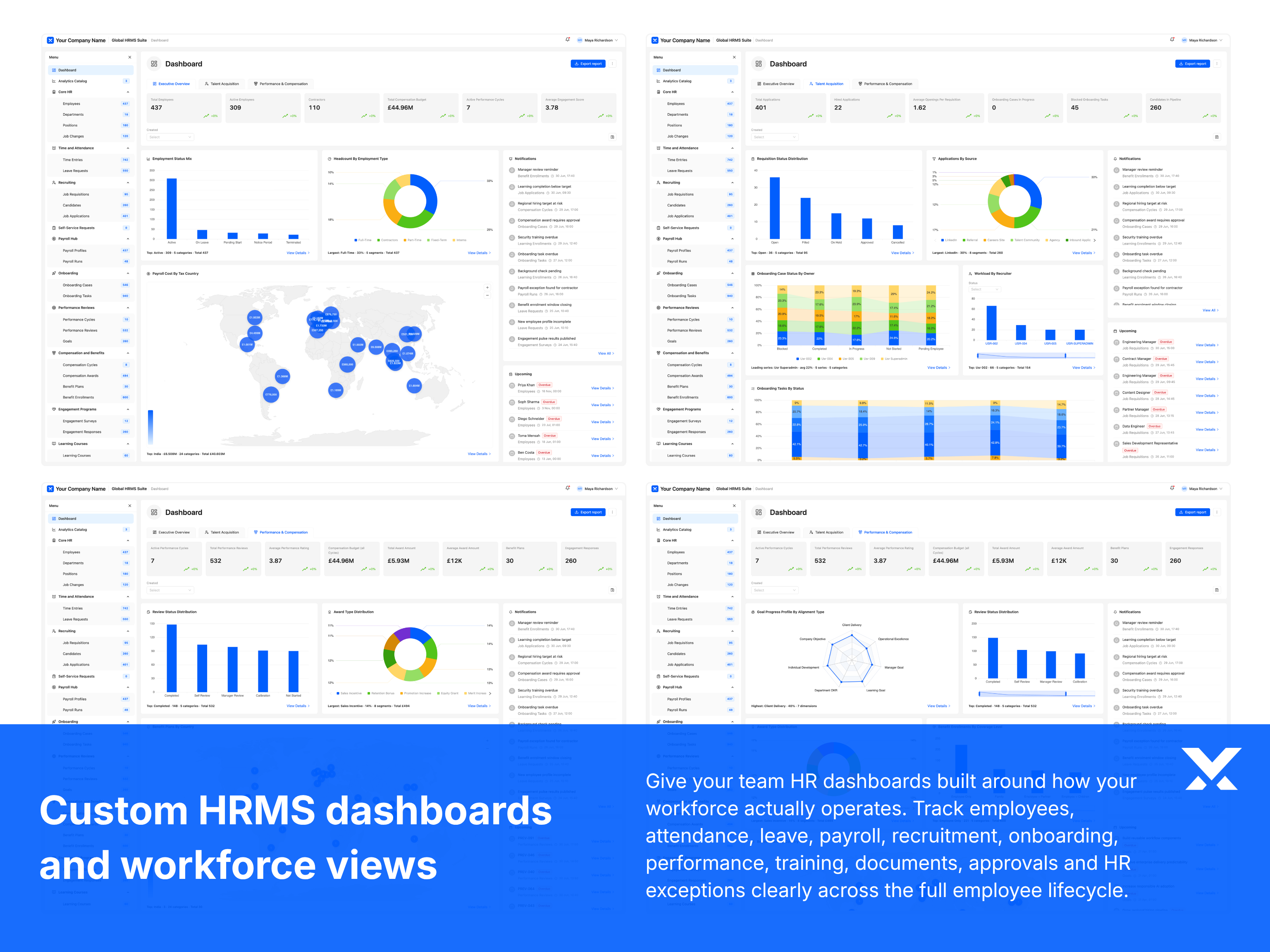
Volt X HRMS can include a full catalogue of custom dashboards built around your HR operating model. Dashboards can be designed around your departments, locations, workforce categories, employment types, approval rules, payroll periods, performance cycles, and reporting format. Each dashboard can also be mapped to roles and permissions, so every user sees the right information for their work.
An HRMS dashboard should help teams run people operations with less manual checking. Volt X can create dashboards that match how your organisation reviews workforce data, manages HR work, and supports managers.
VOLT X ADVANTAGE 2
The most important HRMS modules are the ones that manage employee records, employee lifecycle events, and workforce availability. For most organisations, these are employee management, onboarding and lifecycle management, and attendance and leave. These modules decide how employee data is maintained, how people move through the organisation, and how daily availability is managed.
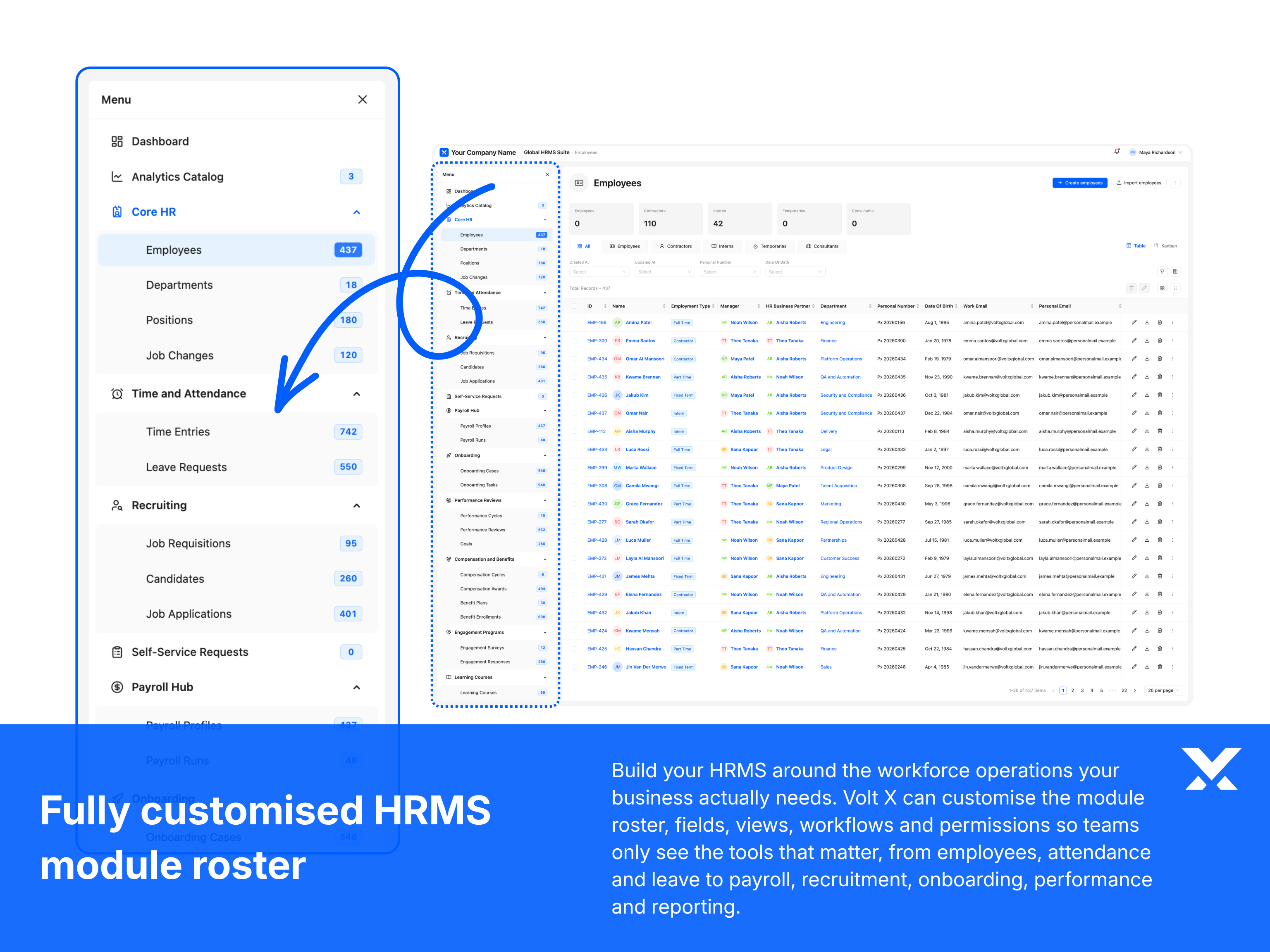
Volt X HRMS can customise these core modules around your actual HR policies and working model. This includes custom fields, forms, labels, employee categories, approval steps, document rules, lifecycle stages, attendance rules, leave types, manager views, and reporting views. The HRMS uses the same terms, policies, and workflows your HR teams already use.
When the main HRMS modules match your actual HR process, teams spend less time fixing data and chasing updates. Volt X can build these modules so the HRMS supports how your organisation hires, onboards, manages, supports, and transitions people.
VOLT X ADVANTAGE 3
Not every organisation needs the same HRMS modules. Some need performance management. Some need payroll inputs. Some need recruitment, learning links, employee helpdesk, workforce planning, benefits, expenses, policy acknowledgements, or compliance records. A custom HRMS should allow you to choose what belongs in the product.
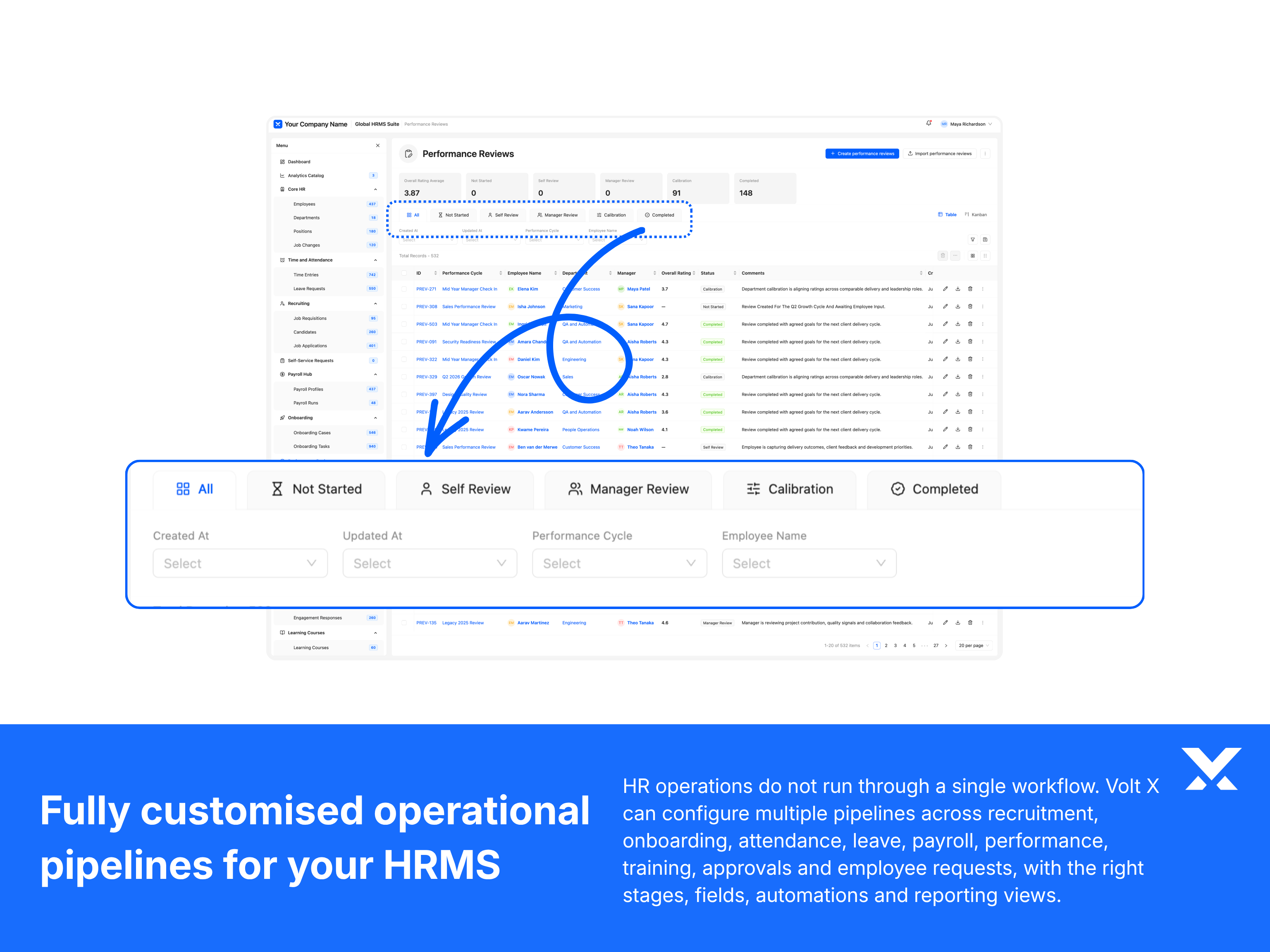
Volt X HRMS starts with a base HRMS product system, but every module can be adjusted. You can keep the modules you need, remove the ones you do not need, rename modules using your own HR language, and customise forms, fields, workflows, reports, permissions, and dashboards inside each module.
This gives you the benefit of a mature HRMS starting point without being locked into a fixed HR platform. Volt X can shape the product around the modules your teams actually need, with the right names, fields, views, and workflows.
VOLT X ADVANTAGE 4
HR data needs careful access control. Not every user should see every employee record, salary detail, performance review, attendance issue, document, payroll input, or leadership dashboard. At the same time, access control should not make HR work difficult.
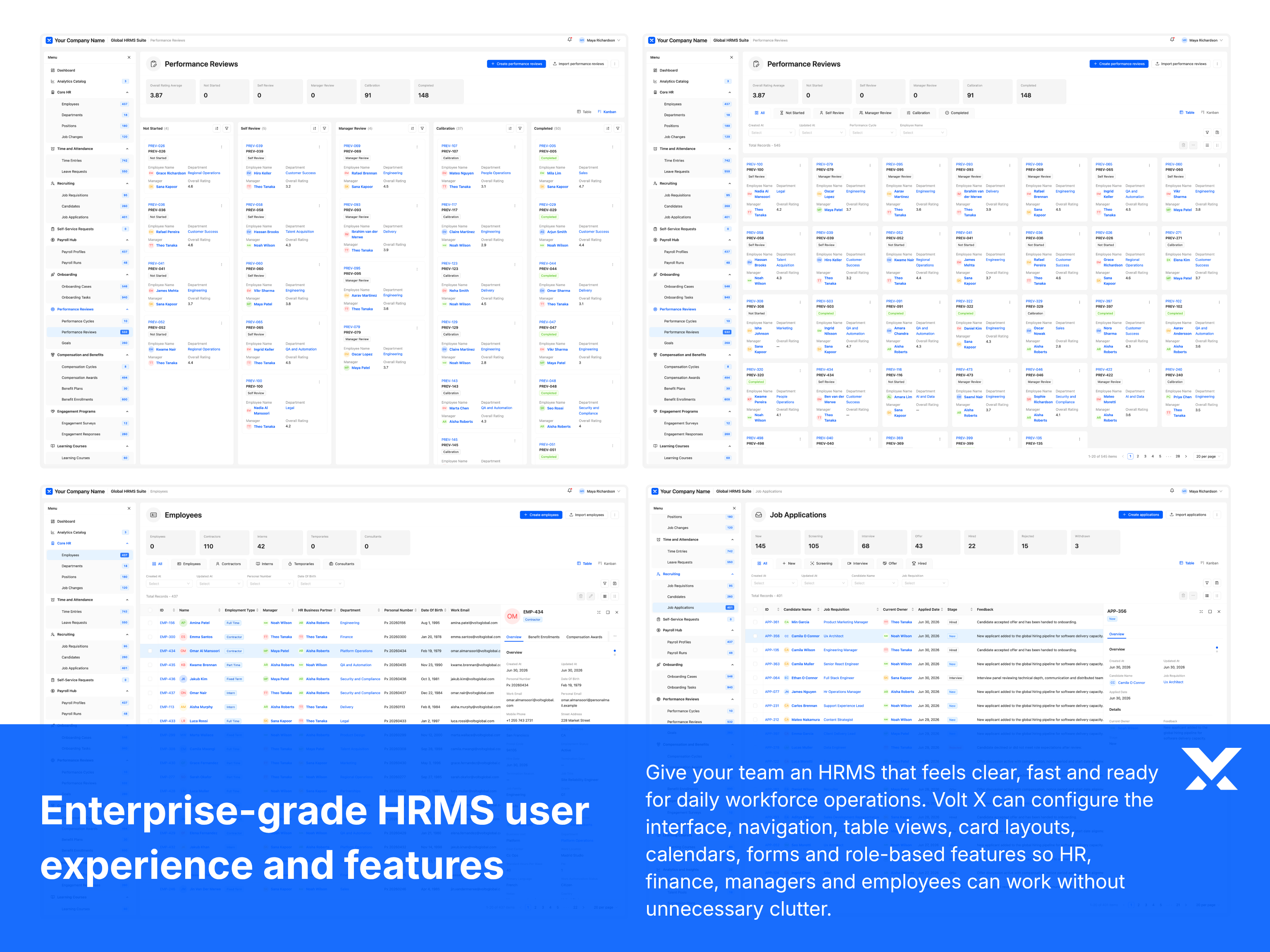
Volt X HRMS includes four RBAC modules in every product system: users, user groups, roles, and permissions. These can be customised around your organisation structure, departments, locations, manager hierarchy, HR teams, payroll users, finance users, leadership access, employee self service, and internal policy rules.
Good RBAC makes an HRMS safer and easier to use. Volt X can configure access so each user sees the records, actions, dashboards, and reports needed for their role, without exposing sensitive employee information.
VOLT X ADVANTAGE 5
HRMS notifications should help people act on time. They should not flood employees, managers, and HR teams with generic alerts. Many off the shelf systems make notification rules too rigid, which leads to missed approvals, late onboarding tasks, payroll gaps, and too much manual follow up.
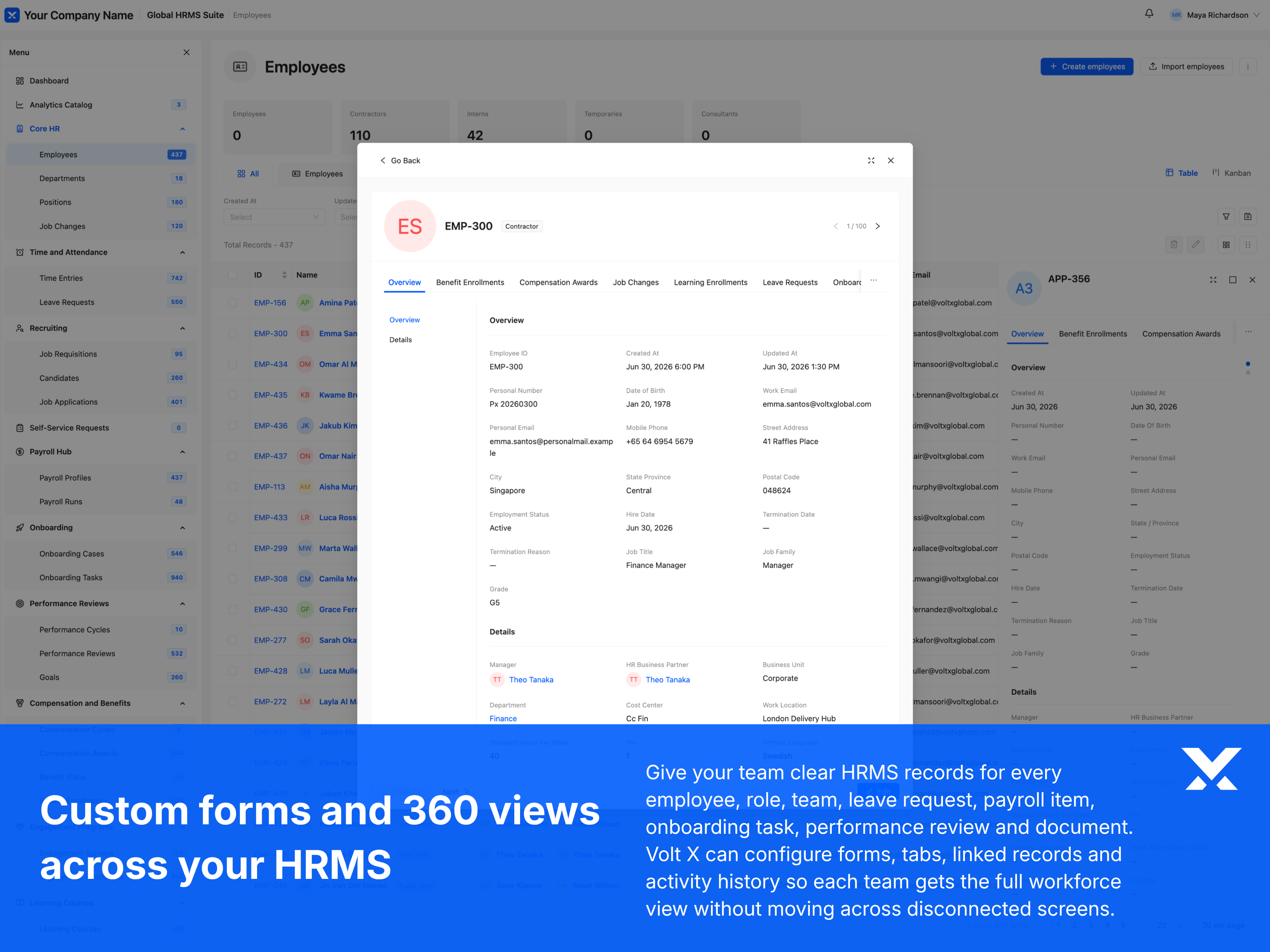
Volt X HRMS can include a custom notification module built around your HR policies, onboarding steps, leave rules, payroll periods, performance cycles, document requirements, and user roles. Notifications can be configured by module, trigger, priority, recipient, timing, channel, and business condition.
The goal is not to create more HR alerts. The goal is to make notifications useful. Volt X can build notification rules that help employees, managers, HR, and payroll teams act on time without adding unnecessary noise.
VOLT X ADVANTAGE 6
HRMS users often need access away from a desk. Employees may need to apply for leave, download a document, or check request status. Managers may need to approve leave or review team availability. HR teams may need quick visibility into urgent tasks, onboarding progress, or employee requests.
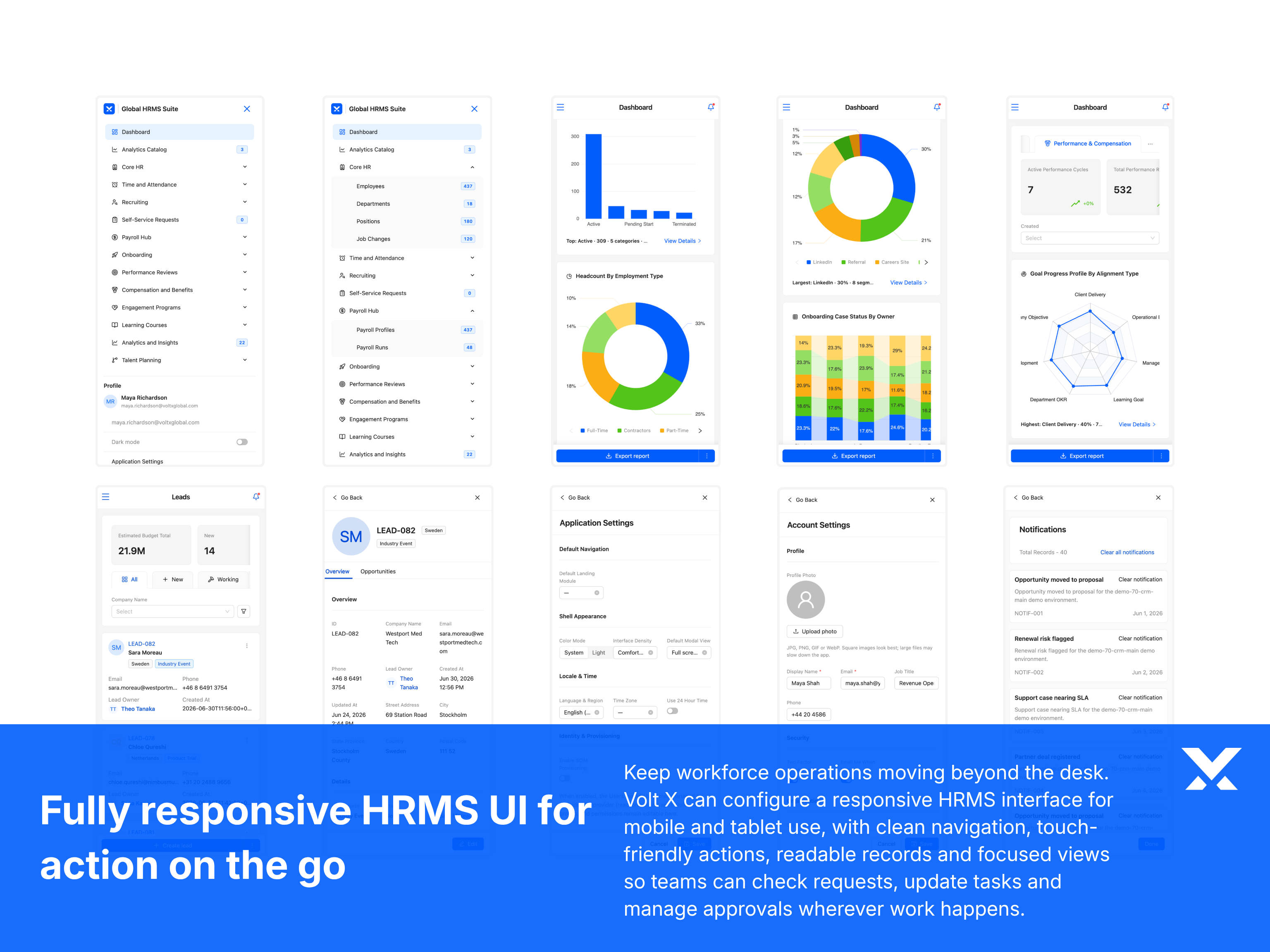
Every Volt X product is responsive and can support mobile views. For HRMS, the mobile experience can be configured from full web parity to a focused mobile version. Some roles may need full HRMS access on mobile. Others may only need self service, approvals, notifications, documents, and quick updates.
Mobile HRMS should not simply shrink the desktop product into a smaller screen. Volt X can configure mobile views module by module and role by role, so each user gets the right HR features when they need them.
VOLT X ADVANTAGE 7
Strong enterprise software is not only about modules and workflows. It is also about how easy the product feels during daily use. Every Volt X product system includes a consistent set of interface controls so teams can work in the layout that suits them, without waiting for custom development.
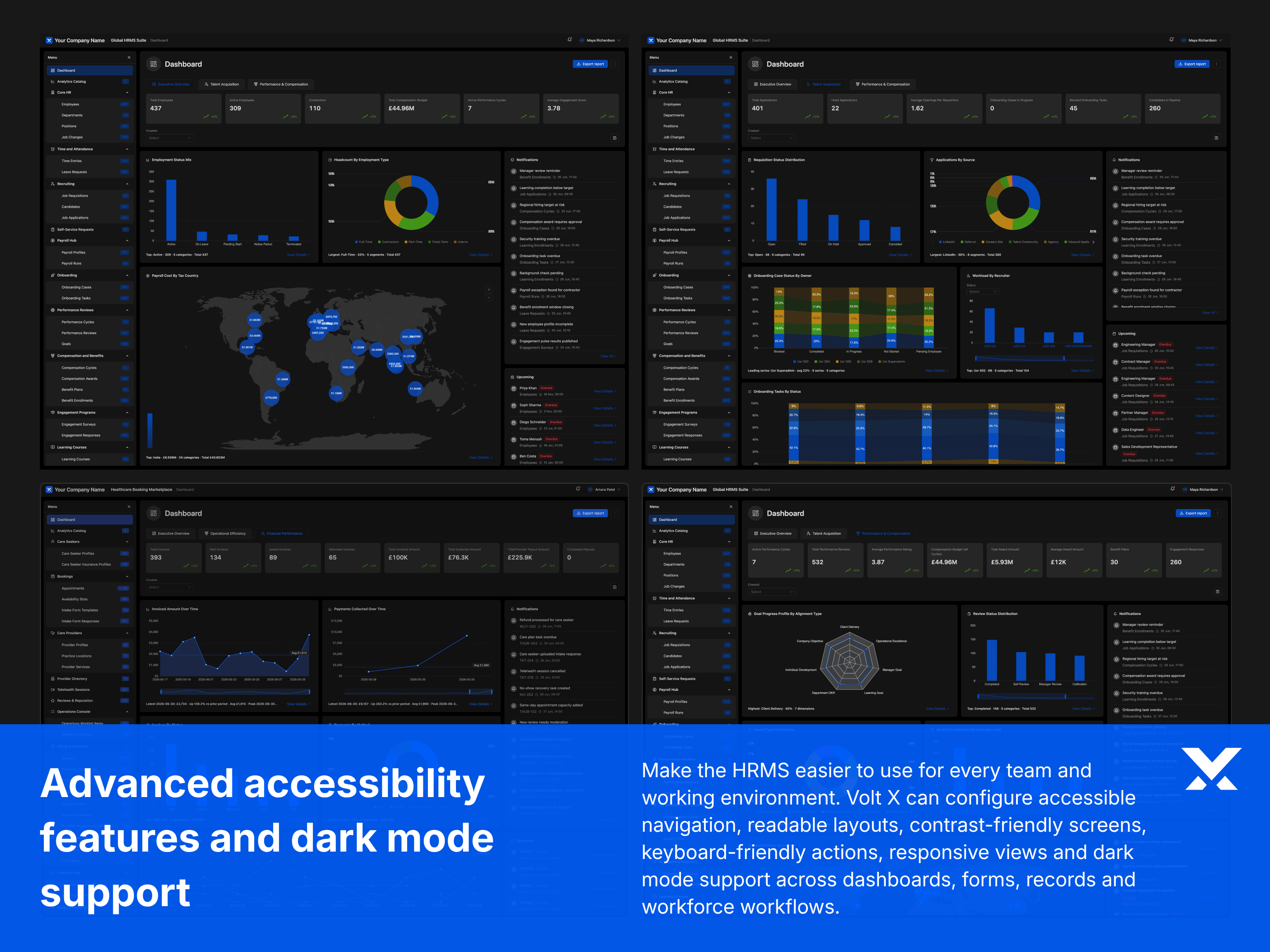
That includes list and card views, column management, hide-and-show stats cards, saved filtered views, dark mode, and the other small but important controls that make a product system feel mature from day one.
These controls are part of the shared Volt X product foundation, not optional extras. Teams can tune how data is shown, hide noise, save useful views, and switch display modes while staying inside governed permissions and audit rules.
Enterprise controls
A high quality HRMS must do more than store employee records. It also needs the enterprise controls that make the system dependable: users, roles, permissions, configuration, auditability, integrations, security, and operational governance.
These controls are adapted to the HRMS context so your teams can manage employee data, approvals, documents, policies, reporting, configuration, and integrations without turning everyday HR administration into a technical dependency.
Volt X delivery model
This gives every project a strong starting point across workflows, data, roles, permissions, interfaces, and delivery logic before customisation begins.
This model gives you the flexibility of custom software without turning the project into an open ended build. Whether we start from a known product category or a new business use case, Volt X creates a structured enterprise foundation first, then shapes the software around your workflows, approvals, integrations, reporting needs, brand system, and operating model. The result is software that feels tailored to your business, but is built with the structure, consistency, and quality control of a mature product system.
No licensing trap
Licensed off-the-shelf software keeps you renting seats, accepting vendor roadmaps, and paying repeatedly for capability you never fully control. Volt X builds customised enterprise software that is deployed into your environment and delivered as a software asset your organisation owns.
That ownership changes what is possible: you control the roadmap, define the data boundary, extend the software on your terms, and where your strategy allows, productise, white-label, or offer the solution to a wider market. No perpetual subscription dependency. No vendor holding the keys.
Your cloud, your data residency rules, your security boundary. The software runs where your governance model requires, not on a vendor-controlled multi-tenant estate.
After delivery, the application is your organisation's software asset, not a rented instance or a licence that disappears when commercial terms change.
The custom software we build for you is not sold back to you through per-seat licensing. It is deployed into your environment as software your organisation owns.
Where your strategy allows, you may productise, white-label, extend, or offer the solution to a wider market. Those freedoms are often constrained by licensed platforms. With owned software, they can be defined around your commercial strategy.
You are not dependent on someone else's release calendar, pricing changes, feature removals, or end-of-life notices. Your team can operate, extend, and integrate the software on your terms.
Every Volt X solution is shaped around your workflows, roles, approvals, integrations, data structures, and brand before delivery, so what you own already reflects how your organisation operates.
Adjacent products
Pair HRMS with other Volt X foundations so people, payroll, operations, finance, and customer systems stay aligned on one lineage.
Start a conversation
We look forward to hearing from you.
What happens next
Prefer email? business@yourvoltx.com
Product System Highlights
A structured view of the Human Resource Management System foundation, module breadth, data model depth, operational coverage, and the product system elements that support serious enterprise delivery.
Business modules
Structured modules covering the core workflows, entities, and operational areas expected from a mature product system foundation.
Total attributes
Data fields, properties, and configuration points mapped across modules so the product system can be shaped to your business model.
Operations and actions
Defined operations, transitions, and user actions that support day to day execution across teams, roles, and workflows.
Additional value adds
Extra capabilities, accelerators, and product system extensions that strengthen usability, control, and delivery beyond baseline modules.
Configurable workflows
Workflow patterns, approval paths, and process structures that can be tailored without rebuilding the underlying product foundation.
Integration touchpoints
Connection points for data exchange, APIs, events, and third party systems so the product system fits into the rest of your enterprise applications.
Proof of value
Volt X HRMS is designed to improve the operating performance of your HR function by strengthening employee data quality, manager self service, onboarding discipline, attendance visibility, payroll readiness, performance cycles, compliance evidence, and workforce reporting.
When tailored around your HR operating model and adopted properly by your teams, Volt X HRMS can help deliver measurable gains across HR productivity, employee experience, manager efficiency, payroll control, and people operations.
Potential payroll administration reduction
Volt X HRMS is built to reduce the manual work around payroll preparation by connecting employee records, attendance, leave, compensation changes, approvals, deductions, and payroll inputs in one governed flow. With the right configuration, payroll administration effort can potentially reduce by up to 75%.
Potential weekly manager time saving
Volt X HRMS gives managers direct access to employee information, scheduling context, performance records, learning status, leave balances, approvals, and team actions. With the right self service workflows in place, managers can potentially save around eight hours per week across paperwork, training coordination, and scheduling related work.
Potential new hire productivity improvement
Volt X HRMS is designed to make onboarding structured, consistent, and trackable across HR, managers, IT, finance, compliance, and the employee. With a strong onboarding process, organisations can potentially improve new hire productivity by around 50%.
Potential recruitment administration reduction
Volt X HRMS can support recruitment and offer preparation by structuring requisitions, candidate records, approvals, interview feedback, offer documentation, and hiring handoffs. With the right workflows in place, recruitment documentation effort can potentially reduce by around 60%.