Business Environment
The product was shaped for compliance, operations, and risk teams responsible for customer due diligence, case review, compliance monitoring, and ongoing profile maintenance in a finance setting.
Case Study
Volt X designed and built an Agentic KYC Orchestrator for a finance operations context where customer risk review, KYC cases, compliance alerts, and operational reporting needed to work as one controlled system. The platform replaced scattered review activity with structured case workflows, risk visibility, SLA tracking, audit friendly records, and dashboard led operational control.
Project Impact
The project focused on reducing the operational drag of manual KYC review while improving evidence, ownership, and visibility across compliance teams. Metrics below reflect the practical impact of bringing customer risk, case workflows, alerts, and reporting into one governed product foundation.
Faster Case Review
Structured queues, ownership, filters, and case states helped reduce the time spent moving cases from intake to review decision.
Less Manual Follow-Up
Centralised records, alerts, assignment views, and workflow status reduced repeated chasing across email, spreadsheets, and separate trackers.
Better Operations Visibility
Dashboards, funnels, SLA views, and risk widgets gave managers a clearer view of backlog, review status, validation activity, and priority cases.
Fewer Unowned Cases
Clear assignment, ownership status, review queues, and priority visibility significantly reduced the number of KYC cases sitting without an accountable next action.
Project Context
The client context was a regulated finance environment where KYC activity involved multiple customer types, review stages, risk categories, validation checks, alerts, exception paths, and reporting needs. Teams needed a clearer way to manage case volume, understand risk, assign ownership, track progress, and preserve evidence without depending on scattered operational tools.
The Challenge
KYC workflows create pressure at several points at once: customer data quality, risk classification, ownership, review queues, compliance alerts, SLA expectations, and audit evidence. The challenge was not only to design a cleaner interface, but to create a product structure that could make regulated work easier to manage without weakening control.
Project Objectives
Success meant creating a product foundation that allowed compliance teams to manage KYC cases, customer profiles, risk indicators, alerts, and reporting from one controlled environment. The platform had to improve daily productivity while supporting auditability, access control, and future workflow expansion.
Our Approach
Volt X approached the product as a regulated operations platform, not as a dashboard only build. We first mapped users, case states, risk data, alert types, review actions, reporting needs, and governance rules, then used enterprise product patterns and Blaze enabled delivery to shape the working product foundation quickly and consistently.



Understand the operating reality
We mapped the KYC review lifecycle across customer profiles, case queues, risk indicators, compliance alerts, ownership, SLA pressure, and escalation points. This gave the product a clear operational foundation before interface production began.
Define the product structure
We converted the operating model into modules, records, tables, dashboards, filters, case actions, customer profile views, risk fields, and alert states. This created a clear product skeleton for the KYC orchestration layer.
Apply enterprise patterns
We applied proven enterprise patterns for tables, filters, status chips, metric cards, charts, detail views, audit actions, exports, and operational dashboards. This kept the interface consistent across every KYC and compliance module.
Customise around the business delta
We customised case stages, risk labels, customer attributes, alert types, ownership fields, filters, dashboards, and reporting views around the specific KYC operating model. The platform stayed structured while still reflecting the business reality.
Build, validate, and refine
We built the working interface foundation, validated it against realistic KYC scenarios, and refined the product around case handling, customer risk review, alert management, and dashboard visibility. The result was a release ready product foundation with room to extend.
The Solution
The delivered product brought dashboard intelligence, KYC case management, customer profiles, risk data, compliance alerts, filters, tables, actions, and reporting widgets into one coherent platform. It gave compliance teams a structured way to review cases, monitor customer risk, act on alerts, and manage operational workload from a single product foundation.
The product experience was designed around the way compliance teams actually work: scanning the dashboard, prioritising cases, reviewing customer risk, handling alerts, and tracking operational progress. Every major module used consistent tables, filters, status indicators, action controls, and dashboard patterns to reduce cognitive load.
The platform was shaped as a modern full stack application foundation with a strong front end system, API ready architecture, structured data persistence, integration readiness, and operational controls. The stack below reflects a realistic enterprise delivery setup for this type of regulated workflow product.
The interface used a component driven front end with consistent dashboards, data tables, filters, status indicators, and responsive layouts for operational users.
The application layer exposed structured services for cases, customers, alerts, dashboard metrics, actions, and configuration using clean API contracts.
The data model supported customer profiles, KYC cases, risk indicators, alert records, status history, assignments, and operational reporting.
The architecture allowed integration with identity checks, screening providers, customer systems, notification services, and downstream reporting environments.
The deployment model was designed for secure hosting, controlled environments, repeatable builds, and scalable application operation.
Operational visibility was supported through logs, metrics, application traces, uptime checks, and issue monitoring across the product environment.
Product Walkthrough
The walkthrough follows the core operational rhythm of the platform: start with dashboard visibility, move into KYC case review, inspect customer risk, handle compliance alerts, and manage the control layer that keeps the product governed.
Walkthrough 1
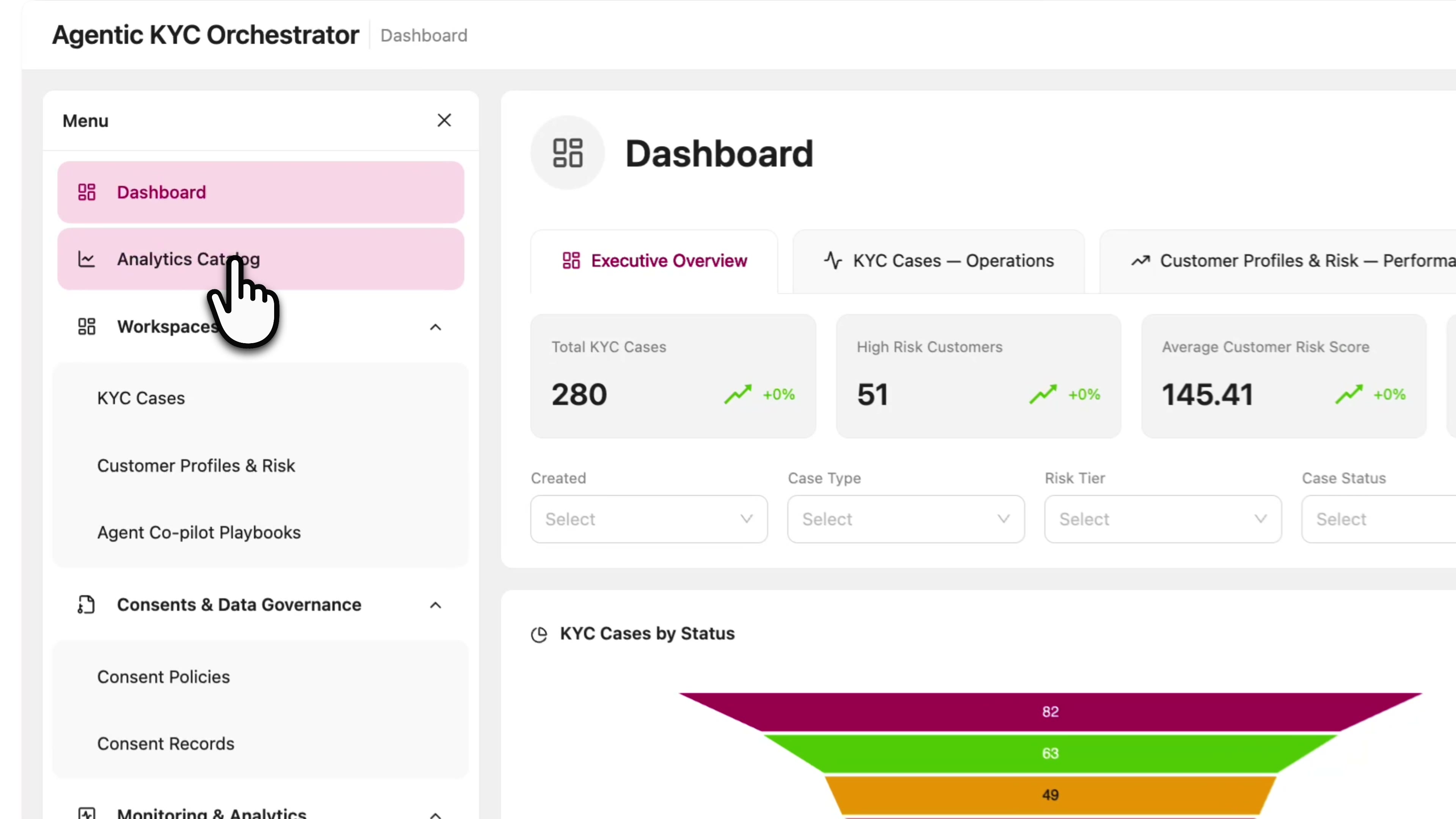
The main dashboard gives compliance teams a live operating view across customer volume, KYC status, validations, SLA pressure, case trends, risk distribution, and urgent work. Managers can quickly identify bottlenecks, priority queues, and review pressure without assembling separate reports.
The dashboard acts as the command centre for KYC operations and management review.
Walkthrough 2
The KYC cases module gives analysts and reviewers a structured queue of customer cases with ownership, risk indicators, stages, assigned users, review dates, and action controls. Filters, views, and export actions allow teams to prioritise work and manage case progress without leaving the workspace.
KYC case queues are designed for prioritisation, assignment, review, and operational tracking.
Walkthrough 3
Customer profiles and risk views bring key customer attributes into one structured workspace, including customer type, risk status, onboarding data, last review date, next review date, contact details, and assigned ownership. The goal is to make profile review faster while preserving a clear customer risk context.
Customer risk records give analysts the context needed to review and act with confidence.
Walkthrough 4
The platform includes role based access controls and notification rules so KYC work reaches the right people at the right time. Compliance analysts, reviewers, managers, and administrators can operate from permissioned views, while alerts and review triggers help teams act on priority cases, escalations, SLA risk, and missing follow ups.
RBAC and notifications keep sensitive KYC work controlled, routed, and visible without relying on manual reminders.
Walkthrough 5
The compliance alerts area gives teams a controlled way to review alert types, severity, priority, assignment, escalation, and resolution status. Together with configuration areas for policies, consent, workflows, and exceptions, this creates a stronger control layer for regulated operations.
Alerts and configuration modules help the platform support policy changes and operating control.
Blaze and Delivery Advantage
Blaze accelerated the product by converting reusable enterprise patterns into a structured KYC foundation: dashboards, cases, records, filters, role paths, tables, alerts, charts, and workflow states. The benefit was not loose AI generation. It was controlled software creation with deterministic patterns, consistent UI contracts, and clean ownership after export.
Time to Completion
The product foundation moved from structured scope to working interface and workflow foundation within an 8 week delivery cycle.
Core Delivery Team
The project was delivered by a compact senior team covering product architecture, UX, front end engineering, and delivery control.
Delivery Spend Saved
Structured product systems and Blaze enabled delivery reduced expected delivery effort compared with a traditional custom build model.
Product Modules
The platform foundation covered dashboard, KYC cases, customer profiles, alerts, workflows, policies, consent, monitoring, exceptions, reporting, and configuration areas.
Shipped Features
Features included tables, filters, charts, funnels, heatmaps, exports, ownership fields, review states, alert queues, status labels, and role based actions.
User Satisfaction Score
Internal review users rated the product highly for clarity, workflow visibility, navigation consistency, and operational usefulness.
Project Impact
The project focused on reducing the operational drag of manual KYC review while improving evidence, ownership, and visibility across compliance teams. Metrics below reflect the practical impact of bringing customer risk, case workflows, alerts, and reporting into one governed product foundation.
Faster Case Review
Structured queues, ownership, filters, and case states helped reduce the time spent moving cases from intake to review decision.
Less Manual Follow-Up
Centralised records, alerts, assignment views, and workflow status reduced repeated chasing across email, spreadsheets, and separate trackers.
Better Operations Visibility
Dashboards, funnels, SLA views, and risk widgets gave managers a clearer view of backlog, review status, validation activity, and priority cases.
Fewer Unowned Cases
Clear assignment, ownership status, review queues, and priority visibility significantly reduced the number of KYC cases sitting without an accountable next action.
Final Outcome
Beyond the measurable gains, the biggest outcome was operational confidence. The platform gave teams a clearer way to manage customer risk, prioritise review work, handle alerts, and explain the state of KYC operations without relying on disconnected tools.
Build With Volt X
Volt X helps teams turn regulated operating complexity into custom enterprise software with stronger structure, faster delivery, and better long term control. If your team needs a governed product foundation for finance operations, compliance workflows, or risk review, we can help shape it.
The Volt X view
Insights on product strategy, software architecture, enterprise UX, modernisation, AI adoption, and delivery discipline. These notes reflect how Volt X thinks about building software that is practical, scalable, and useful in real business environments.
Start a conversation
We look forward to hearing from you.
What happens next
Prefer email? business@yourvoltx.com